
By: Match Group Research Team
Artificial intelligence has become part of the fabric of daily life. It’s in our workplaces, classrooms, search bars, and group chats. For most, it’s a background utility now used without much thought.
But dating is different. It’s one of the few areas of life where efficiency isn’t really the point, and where vulnerability and uncertainty are part of what makes it meaningful. So when AI started entering that space, we wanted to know: what do singles really think about AI’s role in their love lives?
To find out, Match Group surveyed approximately 1,000 U.S. singles ages 18 to 39 between April 13 and May 8, 2026, asking about their beliefs, expectations, and concerns around AI, dating, and relationships.
What singles told us was consistent and clear: they are open to AI when it helps remove friction from the dating experience. But when it comes to love, there is no substitute for real human connection.
AI Is Already Part of Daily Life
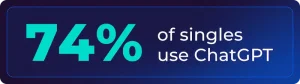
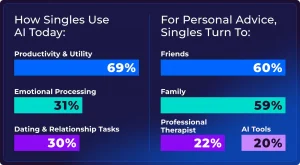
Nearly three in four U.S. singles ages 18 to 39 say they use tools like ChatGPT regularly, and 69% rely on AI primarily for productivity: summarizing information, drafting content, solving problems, and getting things done faster. When asked how they feel about AI across a range of uses, singles were most likely to say ‘very positive’ about practical applications including skill learning (30%), fact-checking (27%), and career or financial advice (20%).
But when the question shifts from work tasks to matters of the heart, the positivity drops significantly.
Where Singles Draw the Line
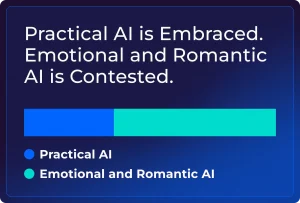
Despite widespread comfort with AI as a utility, nearly half of singles (47%) view AI in romantic contexts negatively. And when it comes to actually dating an AI, the rejection is near-universal: negative sentiment outweighs positive sentiment roughly 4 to 1, making it the only AI use case that singles reject outright.
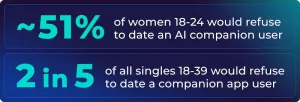
Companion AI use is a dating dealbreaker, especially for women. Two in five singles ages 18 to 39 say they would refuse to date someone who uses an AI companion app. Among women ages 18 to 24, that rises to 51%.
For the small share of singles who have experimented with companion apps, the motivation is rarely connection. Among the 12% of 18–24-year-olds who reported trying a companion app in the past three months, most said they used it for boredom and entertainment (45%) or role-play and simulation (43%) — outweighing building genuine connection (38%) or processing emotions (26%). For most, companion AI appears to be novelty or experimentation, not an emotional substitute.
For deeper personal advice, singles still overwhelmingly turn to friends (60%) and family (60%). Only 20% turn to AI for that kind of guidance. The hierarchy is clear: AI is a tool for tasks. People are for feelings.
At the emotional core, people want the same things they’ve always wanted from relationships. To be truly known by someone, to be chosen, and to feel genuinely connected. That’s not something they’re willing to outsource, but it doesn’t mean they’ve closed the door on AI entirely.
Where Singles Welcome It

While singles reject AI as a replacement for connection, nearly two-thirds (64%) can see AI helping their dating journey. The key distinction is solving for key friction points.
Practical, task-oriented AI is embraced. When asked which specific dating tasks AI might be able to assist with, the top responses centered on making the path to real connection smoother, such as helping support a dater to: keep a conversation going (27%), build a stronger profile (27%), start a conversation (26%), or planning a date (24%).
Singles are most receptive when AI is assistive. They are not asking for romance to be automated. They are asking for dating to be more seamless.
What This Means
Ask singles what they want from AI in dating, and the answer is pretty consistent: help with the hard parts, but hands off for the human parts. Yes, they’ll use it to help them punch up a profile or for help figuring out what to say when a conversation goes quiet, but the actual connection is still theirs to create.
The goal, for singles, has not changed. They want real connection. They’re just open to a little help finding it.
